Best Foods
Fast Foods
Nice Food

Kamis, 17 Juni 2010

New Articles


What’s the Matter With Chinese Football?


Type in “China football why bad” on Google and a slew of answers quickly present themselves. Among the first hits are news articles detailing sex scandals, corruption prosecutions, and lopsided game losses. There aren’t a lot mentioning victories.

The question remains why?

Message boards are full of theories—mostly ignorant or racist—that don’t hold up on close examination: If Chinese people are too short, Pele and Maradonna have some explaining to do. If China’s developing country status is to blame, then Brazil and most African countries should be doomed to failure. If a certain national apathy toward the sport were the cause, the US shouldn’t be qualifying either.

Rather the problem seems largely to be the way sport is organized in the country. Sports where China does well—swimming, hurdling, and gymnastics for example—are heavily state-directed. Students are selected early and groomed for athletic success. Football is not among the sports that received a great deal of government largess.

In many countries there exist competitive and thriving professional football associations. These teams develop players over years. China’s Super League (CSL), however, is a shambles, currently under investigation for massive corruption. So far over twenty people—including many league executives—have been arrested for game-fixing and gambling. Apparently, entire teams were co-opted by criminal organizations and induced to take dives.

And, although it may be something of a chicken or the egg question, even if these institutions were running smoothly, the society at large is not focused on the sport (and sports in general) with the same enthusiasm as elsewhere. Football remains the most broadcast sport on CCTV5, but talk to Chinese children about which sports they enjoy and the answer will typically be ping pong and basketball. The former has long been popular and the latter has an internationally famous player to look to.

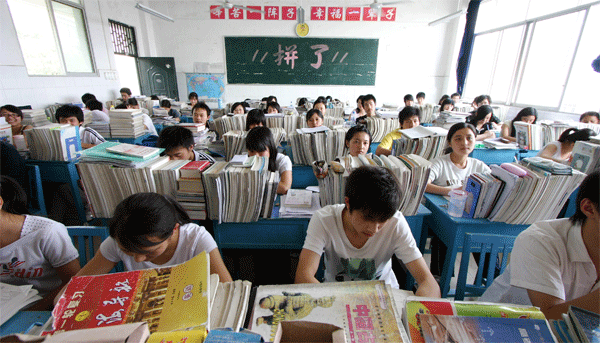
Nor are sports looked on as a legitimate career path to pursue. From a young age students are pressured to focus on their academics and prepare for the grueling and decisive test that awaits. Non-academic extra-curriculars are kept to a minimum in China. Inter-school athletics are negligible. School life does not revolve around athletics as it often does in the States. A kid with a passion for football just won’t find the same degree of family and community support as he would in Europe and elsewhere.

Finally, there is the simple fact that the Chinese team just isn’t that good. It’s in the same division as Japan, North Korea, and South Korea, all of which field competitive teams. China has won against major national teams in “friendlies”—it’s only the qualifying matches where success consistently alludes them. When they last made it to the World Cup in 2002, they failed to secure a single goal in three games.

In the following years the team has not faired much better. Besides losing when it counts, they have developed a bad reputation for thugishness—Tan Wangsong kicking a Belgian player square in the crotch during the Beijing games led a fan to quip that, although the team had failed to medal in football, they’d won “a medal in martial arts.” Similarly, the thirty-man melee between the Queen’s Park Rangers and China’s under-23 team in 2007 did nothing to soften the image.

All is not lost of course. Bad as they have since performed, the Chinese did make it into the World Cup only 8 years ago and the women’s team was in the 1999 finals. In sheer numbers, China commands the world’s largest football fan base. Perhaps a great Chinese player will emerge to inspire youths to play more and encourage parents to cheer them on. Or perhaps hosting the games will become the next big national ambition now that the Olympics are past and the Expo is nearing its close; such a moment on the international stage might spur the country to finally achieve.

In the meantime, however, China lags behind the competitors and pin-pointing the precise cause will doubtless remain a topic of barroom debate for years to come.


The Gaokao


Articles by western writers about the gaokao, China’s annual college entrance examination, always lead off with anecdotes; stories of parents crowding around schools in nervous vigil, of cities enforcing two-day long construction suspensions and noise-pollution bans, of tearful late arrivals begging on their knees to be let in, of taxi drivers given special right-of-way dispensations if carrying test-takers test-centers, of criminal rings busted for selling thousand dollar cheating apparatuses, of girls taking pills to insure their physical and academic schedules do not accidentally align, of students committing suicide in desperation. In short: Collective hysteria.

To westerners—certainly an American like myself—there is something mad about the test. Our own SATs are stressful, but they are not the be all and end all. A middling score combined with obvious talent—say sporting prowess or community involvement—can open as many or more doors than mere good grades.

Yet China is not like this. Whereas social life in American school revolves in large part around extra-curricular activities, for Chinese no such thing exists. School can last over ten hours a day, five days a week. Weekends are full of English classes, music lessons, and math preparation. Evenings consist of studying, watching tv, and temporarily escaping stress through online gaming and chat.

Years of school lead up to the gaoako and amid an array of statistics—9.5 million test takers, 6 million spots, a 68% acceptance rate for university—one stark number explains it all: 70,000 of this year’s college graduates are still unemployed. Over the past decade, in addition to the boom in apartments and factories, there has been a boom in universities. Whereas 1 million Chinese graduated in 1998, 6.3 million did last year. Job creation is not quite keeping pace and the gap in quality between universities is seen as being the crucial difference. Get into a good school and a job is assured, get into a second tier university and nothing is certain. (The five year olds whom I teach English to may not realize it, but they are already fighting for their futures.)

Tests as the sole portal to advancement are a Chinese tradition dating back nearly 1500 years. The test in its current form dates to 1978 when Deng Xiaoping reintroduced it as part of his reforms. Initially controlled entirely by the Ministry of Education, its devising has been handed over to the provinces during the subsequent years. Depending on the province, students must select their universities before or after the test. This often results in a student doing better than necessary for the school he chooses or, even worse, a low score preventing a student from attending the schools he has listed.

Universities for their part set quotas of how many students will be accepted from each province, the lion’s share given to their own provinces. Test scores are the main criterion for choosing who makes the cut. Other (marginal) considerations include minority status and success in various academic competitions.

For years the exam was held in July, but for the past several years it has been administered in June as to avoid the intense summer heat that blankets China.

The test itself is nine hours long and divided into three required topics: Chinese, Math, and a foreign language. Six other topics (Chemistry, Physics, Biology, History, Politics, and Geography) are usually chosen in addition. The most head-scratching part may be the essay portion where students are required to expand on a prompt. Localities can design their own—Shaanxi’s offered an anecdote about how goldfish only grow as big as their bowls and asked students to ruminate on the connection of environment and success—or they can use the nationally provided prompts. This year’s prompts called for students to discuss light reading or to expand on the saying, “Why chase mice when there are fish to eat?”

Abstract as this many sound, it offers room for a modicum of creativity. Most of the test is directly dependent on a student’s aptitude for rote memorization. The persistent criticism of the Chinese education system is its emphasis on teacher-centered learning, the test both reflects and privileges this style of education—even essay responses are the result of endless studying of rhetoric structure.

The overall score is out of 750. Students attempting to enter the nation's best schools—like Beijing’s Tsinghua University need scores between 660 and the low 700s to even have a sliver of hope. By contrast, equivalent programs in Xi’an require scores in the high 400s. With such fierce competition, there is obvious benefit to those whose parents can pay for expensive after-school prep classes.

Yet, if the goal is to equal the playing field for students, the alternatives are not particularly satisfying. Although China’s education and test policies may not encourage outside-the-box thinking, few from western countries can argue with a straight face that their own countries do any better at helping the poor rise up or limiting the benefits that flow from wealth and position.

If China looks to rags-to-riches success stories as evidence that the system is working, many in the upper-middle class are increasingly less convinced. One last statistic is important to consider: Last year as millions of Chinese youths struggled to get into the best national universities, nearly 250,000 opted to go abroad to school instead.

Jumat, 11 Juni 2010

Taste Of Los Angeles

Sorry it's been so long since I chomped it up. Actually I've continued to chomp it up all this time but just haven't had time to snap pics and write about it... ! We went down to Los Angeles for my cousin's wedding in June, and we had a total blast... we ate our way through Los Angeles... a must-do for any trip we go on. I love seeing the foodstuffs that any given city or town or village or weird stop on a long drive can bring you! Rich and I had one day ONLY to explore some of L.A.'s food... we had a huge list... but that day we only made it to 5 spots in 5 hours! ;)

Presenting... the Taste of Los Angeles!

Legendary Clifton's Cafeteria. a 1930s Depression-era cafeteria in downtown Los Angeles.

Great signage!

Love this sign.

A photo of a photo of the pies...

You can't see it too well but picture an "animatronic" raccoon clunkily popping up from behind this wooden facade and catching a fish. Over and over. So excellent.

Main floor, Clifton's

Clifton's pies! Like a Wayne Thiebaud painting!

Clifton's trays all lined up.

The vanilla pudding looked just right! I had to try! With a star-tipped dollop of whip cream. (pretty sure the whip cream was edible oil product)

The hot lunch line! Carved turkey dinner with mashed potatoes and gravy.

Third floor seating! It was roped off but an employee at Clifton's told us to go on up!

Tray of delights: Spanish omelette with side of sausage, unsweetened ice tea with lemon, macaroni and cheese, jalapeno cheese bun, mashed potato, vanilla pudding

"Enjoy"

Reading up on the history of Clifton's

Old Clifton's flyers

The Cliftons! Clifford Clifton, in fact!

Upstairs dining area view

Middle floor dining area: large backlit photographic landscape vistas!

Bye Clifton's!

Next stop: Cactus Taqueria on Vine Street in West Hollywood.

Fish tacos, veggie tacos, rice and beans!

Then, on to "Milk" Bakery & Ice Cream!

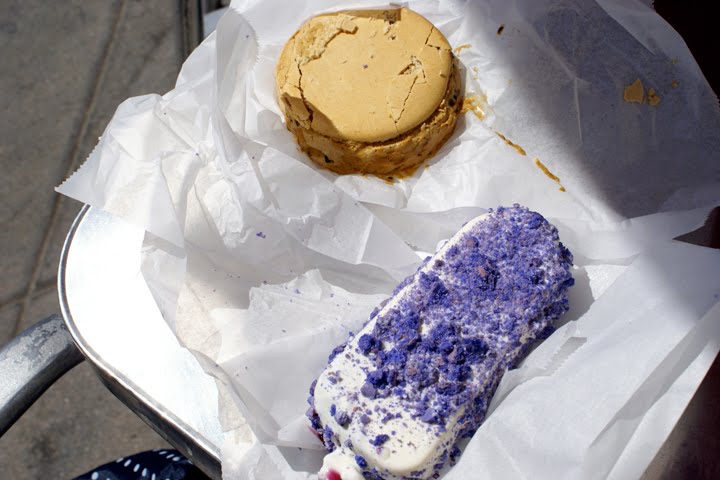
Seriously mental. Caramel macarons sandwiching homemade espresso ice cream with toffee and thick swirls of caramel. Blueberry yogurt bar, fresh blueberries in frozen yogurt, dipped in white chocolate and coated with "blueberry crunch." $4.50/each.

This was really good, but sooo large and pretty sweet!

This was perfect. We should've shared this one only,
but I wanted to try two ice cream novelties...!

Next stop: In N Out Burger! The dreamiest fast food burgers in existence. For real.

The menu is simple: burger, soda, fresh cut fries, milkshake. Everything is fresh and local, service is fast. Vegetarians can get a good burger too -- just hold the patty and enjoy the fresh bun, cheese, grilled onions, crunchy lettuce and tomato!

The Double Double (double patty double cheese, grilled onions) I took home for my Dad! Yep, it flew from L.A. to Vancouver.

Iced tea with lemon, ketchup cup

Two burgers, and cheese covered fries!

My burger: grilled onions, cheese. The burger I had on the way into L.A. from the same In N Out had a bigger hunk of iceberg lettuce, but this was still delicious!

Next time we hit L.A. we will go for way more tacos, hit Joan's on Third, go back to M Cafe (macrobiotic super fresh delights) and go to Pure Luck & Scoops (vegan cafe and ice cream parlour!)

See ya soon, FoodLand!
xo

Jumat, 28 Mei 2010

MIA: Missing in Action/Mother in Action

It's been five months since I've posted. Five life-changing months. On December 17, 2009, my little Jasper was born. He's a healthy, happy baby boy. And, somehow, he's swallowed the last five months of my life whole. Don't know where the time has gone. Yet, somehow, the little 7 lb 6 oz, 21-inch newborn is now 14 lbs 11 oz, and 26 3/4 inches long. All of a sudden, it seems, he's rolling over, and laughing, babbling and grabbing at my food. Clearly, time has passed, but I'm not sure where it has gone.

I'm hoping to start blogging again. The Jazz Monkey appears to be taking naps now. So, perhaps, maybe, if I'm lucky, I will be able to start writing again. Maybe even baking again.

In the meantime, here's to a long weekend, the vegetable garden sprouting, and strawberry season peaking over the horizon.

MIA: Missing in Action/Mother in Action

It's been five months since I've posted. Five life-changing months. On December 17, 2009, my little Jasper was born. He's a healthy, happy baby boy. And, somehow, he's swallowed the last five months of my life whole. Don't know where the time has gone. Yet, somehow, the little 7 lb 6 oz, 21-inch newborn is now 14 lbs 11 oz, and 26 3/4 inches long. All of a sudden, it seems, he's rolling over, and laughing, babbling and grabbing at my food. Clearly, time has passed, but I'm not sure where it has gone.

I'm hoping to start blogging again. The Jazz Monkey appears to be taking naps now. So, perhaps, maybe, if I'm lucky, I will be able to start writing again. Maybe even baking again.

In the meantime, here's to a long weekend, the vegetable garden sprouting, and strawberry season peaking over the horizon.

Sabtu, 22 Mei 2010

Street Food


[Again, this is one of my magazine articles.]

Without a doubt, my most pleasurable moments in Xi’an have come, sitting on little plastic stools at less-than-entirely-sanitary tables, savoring a plate of noodles (5 yuan) and watching the whole madcap nighttime drama of the city unfold around me. I seldom feel more connected with my fellow city-dwellers than I do crowded around a chao bing cart, rummaging amid piles of vegetables, meats, and tofus for the perfect midnight meal combination.

Xi’an is highly regarded for its variety and selection of street food. Weather (and other factors) permitting, you can find vendors at any time of day. That said, the variety of food on offer shifts over the course of the day and there are definite differences between the food one can find in the morning, afternoon and night.

Morning

As early as 7 in the morning, small carts line the streets. Most breakfast food involves either eggs, flour or a combination of the two. The most common morning treats are you bing and you tiao, fried dough. Bing is circular and tiao is long and stretched like a garlic stick; both have a taste reminiscent of a slightly salted donut and neither should cost more than 0.5 to 1 yuan. Typically Chinese will eat these with soymilk. Bing can be stuffed with shredded potato or spiced cabbage.

Another vast category of breakfast food is fried stuffed bread (bing). Unlike the simpler fried doughs, these are filled with chives (cong), eggs (jidan), or meat (niu rou) before they are cooked. Less unhealthy looking are the grilled versions of the same thing. None should cost more than 1-3 yuan.

If your preference is for something less artery-clogging first thing in the morning, options up your alley might include steamed bread (mantou) stuffed with veggies or any of the readily available spicy soups (hula tang). Also low fat is jian bing guozi—essentially a crepe filled with egg, chives, and onions.

Afternoon

Between morning and night a great many vendors either vanish or re-locate. Streets like Dongmu Toushi—at other times overflowing with food—become rather desolate save for men hawking pineapple on a stick (1-2 yuan).

There are notable exceptions. At lunchtime, along the backstreets, women pull out their large lunch carts full of meats, greens, rice, and noodles (kuai can). Most noticeable is along Luomashi Street. During midday, this main pedestrian boulevard, already crowded with shoppers, clothing sellers, and wedding planners, becomes full of food vendors as well.

Food unique to this time of day includes shredded pork sandwiches packed into steamed bread (fen zheng rou). Pancake sandwiches (tong luo shao) which can be filled with fruit jam, red beans, or the far-too-ubiquitous powdery-brown pork floss. My personal favorite are the Chinese Egg-McMuffins (like so much street food, their literal name, egg-meat, has no ring to it). These are nothing more than flour fried in something resembling a cupcake tray, filled with egg and meat. Delicious!

On many streets—especially in the Muslim Quarter—one can see fried starch tofu (chao liangfen). This and the non-fried variety are a gelatinous tofu made from water saturated with either flour, potato, or mung bean starch. This can be eaten cold, topped with sauce or it can be fried with spices. The process that creates these noodles produces excess material which is used for the common—and in my opinion rather off-putting—kao mian jin. Resembling pig-tails, these curly, spiced, barbequed doughs are, essentially, the detritus of cold noodle preparation.

Night

At night time, the streets flood with options. The most common sights are carts loaded down with a selection of vegetables, meats, eggs, mushrooms, and tofu. Choose what you want (typically .5 to 1 yuan per item) and the cook will fry it, boil it, or grill it depending on your preference. The vegetables can then be covered in a spicy chili sauce or a smoother sesame sauce. Similar to these are the fried sandwich (chao bing) carts that will cram all your selections into a fried round of bread.
Nearby are the carts serving fried noodles (chao mian). The typical cart will have a variety of noodle choices—several dry, steamed options, several moist-looking boiled varieties and probably rice to boot. To this can be added either egg (jidan), meat (rou), or, quite commonly, large in-shell shrimp and snails (tianluo). All for around 5 yuan.

Grilled meat skewers (kao rou) are often a common sight. Thin strips of finely-spiced meat are usually served up on a simple metal plate without any addition. The version sold by Uighur people from eastern China, however, will come with a special flat bread to eat in combination.

Among the cheapest options are the carts serving up dumplings (baozi) and wonton soup (huntun tang) both for about 5 yuan. To add flavor, dumplings can be dipped in a flavorful vinegar-chili sauce (tiao liao zhi).

Other choices might include duck meat sandwiches (ya rou) served in steamed bread or the regretfully all-too common stinky tofu (chou doufu) . . .

But, try as I may, this is only a partial list of the potential meals Xi’an offers up. The adventurous or ambitious ex-pat could spend a month of nights trying different dishes and still not taste them all. And herein lies the ultimate charm of Xi’an’s food scene, this superabundance of possibilities. It’s a food lover’s dream.

Rabu, 05 Mei 2010

Reuben Silverman, Cub Reporter


About two months ago, I saw that the local ex-pat magazine China Grooves was hiring volunteer copy editors. I wrote them and letter and set up a meeting; despite the advert, copy editing services didn't seem to interest them, but they told me they could always use some writers. The following are the four little pieces I've written so far.

They're not Mencken or Thompson, but they're not utter shit either:


Beilin Museum

Located beside the southern wall’s Heiping Gate, the Beilin Museum houses a fine little collection of steles and religious artwork from a variety of different dynasties.

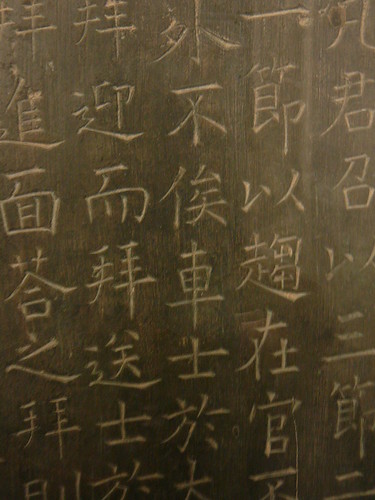
The steles—large, carved stone blocks—are spread through seven rooms. The first contains classic works of Chinese philosophy and ethics. The black slabs, one lined after another, puts one in mind of the Vietnam monument in Washington, DC.

The second features family memorials, records of foreign relations, ennoblements, land-grants, and writings recounting the good deeds of various religious leaders. The third displays poetry, especially impressive calligraphy, and various inspirational accounts of filial piety.

The forth room is the most interesting, offering up a grab bag of steles. Some are portraiture and landscape, others are memorials—one, for example, commemorating a peasant rebellion leader financed paid for by his peasants followers. Another from several centuries later is a warning from the Qing to similarly rebellious peasants.

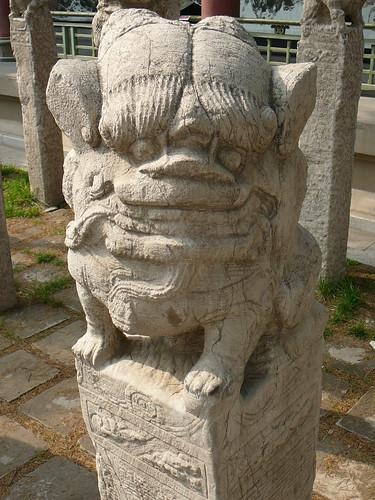
The western wing of the museum is given over to sculptures and carvings discovered in and around burial sites. These include the elaborately designed tomb of Li Shou, a cousin of the then-emperor; massive tomb guardians in the shape of lions, goats, rhinos, and mythical creatures; and “pictoral stones” showing both fantastical imagery—dragons, ghosts, and anthropomorphized animals—as well as more mundane scenes such as hunting and harvesting.

There are also a fair number of Buddhist sculptures. When the religion arrived in China, such artwork was used to educate the illiterate about the faith’s teachings. The museum’s collection ranges from small household relics to large heavenly guardian statues.

The value of the museum’s pieces lies not only in the things themselves, but in the contemplation of how much care and effort—a lifetime of knowledge and craftsmanship—went into their creation. Viewing works so full of passionate labor, one comes a bit closer to understanding lives long past lived.


Yangrou Paomo

Chances are good that, if you’re a foreigner living in Xi’an, a local has probably taken you out for yangrou paomo. If not, it’s only a matter of time. The restaurants are everywhere; lining the streets of the Muslim Quarter, glimpsed down alleyways, even operating out of swank, high-end venues. Inside many city buses, posters advertising the wonders of Xi’an culture show the terracotta army, the Big Goose Pagoda, the Tang Dynasty show and a bowl of yangrou paomo.

This is the local dish and it’s marvelously simple: Bread, noodles, mutton, spices and broth. For the north Chinese with their traditions of horse riding and long distance hunts, the dish was both simple and filling. A Muslim influenced Silk Road dish, it is said to have originated in the 11th century, at the court of the Western Zhou emperors.

In the heavily touristed areas of the city—like Muslim Quarter—you’ll see yangrou paomo sitting in pre-made bowls (9 ¥), just waiting to have broth ladled into it. While this can be tasty, it’s not the customary way to eat it.

In the better restaurants (20 ¥), you’ll first be asked how many pieces of bread (bing) you want. One will be fine if you have a modest appetite, two will certainly fill you. Once your choice has been made, you’ll be handed the bread and an empty bowl.

What follows is a process of breaking the rounds of bread in half and ripping those halves into small pieces. Whereas a machine compresses the bread, ripping by hand keeps it soft and allows it to retain absorbency. The smaller the pieces are, the better they suck up the broth—and, as a friend insisted to me, if I didn’t tear the pieces up small, the cooks would take me for a country-bumpkin and withhold the choice meat slices.

While thorough ripping can take time, Chinese insist that the whole business can have a relaxing, almost zen-like quality. You become part of the cooking process.

Ripping done, the bowls are whisked away and returned several minutes later full of broth, vermicelli noodles, and slices of mutton. Served along with the meal is a spicy chili paste and sweet pickled garlic which can either be eaten on its own or mixed into the bowl.

This is kou tang (mouth soup); it is what you can expect to be served if you don’t specify otherwise. If this doesn’t quite appeal, several other options are available: Dan zou (walking alone) is a version where the broth, meat and noodles are served up with the bread, as yet still whole, on the side, ready to be dipped in. Gan pao (dry soaked) is the standard yangrou pao mo drained of its broth, but still soggy. And, most wonderfully named, is shui wei cheng (water besieged city) which is just your typical paomo bowl brimming with broth.

The best way to eat yangrou pao mo is to work around the outside toward the center. Since the bread is thoroughly soaked in broth, it is quite hot. Avoiding the center of the bowl bypasses the hottest portion and leaves the roof of your mouth intact, allowing you to enjoy Xi’an’s signature dish with the utmost satisfaction.


Banpo Museum

Banpo Museum is itself something of a relic. Old photos near the entrance, show the site in the early 50s, at the time of excavation. A few archeologists stand amid locals. Around them stretch empty fields. Now the place is surrounded by roads and buildings and getting there requires a long bus ride to the eastern suburbs, beyond the Chan River.

The museum displays the remnants of a 6000 year old village. Covered by a large warehouse building are the remains of numerous huts, identifiable by numerous stake holes in the ground. Wooden frames, subsequently filled in with mud and straw, were set in the holes.

Archeologists suspect that the Yangshao culture which inhabited the site was matriarchal (e.g. run by women). Female burial sites contain far more objects than male ones, leading researchers to believe that women’s position in the society was elevated.

In addition to these burial sites, archeologists have unearthed a great deal of pottery used to bury dead children. A number of storage pits have been excavated too, along with a portion of the deep moat which once surrounded the village.

Other buildings contain artifacts from the site and less obviously relevant displays such as animal fossils.

The nicest part of the museum, however, is the least historical part. Outside the main building is a large garden area full of peony flowers and reconstructions of the Neolithic huts. The whole place is in a state of quaint disrepair, but the upshot is that you find yourself able to sit in relative peace and quiet.


Chinese Calligraphy

How does one express his inner nature? How can we best judge a person’s soul? For the imperial Chinese, writing offered the window. Zhang Xu and Huai Shu, two Tang dynasty calligraphers, for example, would get liquored up and launch into shouting tirades as they performed their art. Zhang, it is said, would often use his hair in place of a paint brush. Not surprisingly, the two avoided standard writing styles in favor of freer forms.

Nowadays, when we think of Chinese script, we tend to separate it into Traditional and Standard. When confronted with the thought of learning the former, those of us unable to learn even the latter shudder. Yet both are merely a fraction of the range of characters once in common circulation among literate Chinese. What we think of as “written Chinese” is just kaishu style, the simplest of five possible scripts.

The oldest style of Chinese writing is zhuanshu, or Seal Script. Originating several thousand years ago, it conveys a sense of visual antiquity. The characters are long, narrow, insect-like, almost otherworldly. The impression is far more literal than other, more abstract scripts. It was the official writing style of the Qin dynasty.

Lishu script, or Clerical Script, followed. Much faster to write than Seal Script—and, therefore, more suited to use in bookkeeping—it retains some of the same elongated qualities as its predecessor.

The other three major scripts emerged concurrently during the Han. Two of these, caoshu (Running Script) and xingshu (Walking Script), are cursive versions of the clerical script. As the names suggest, caoshu is the more flowing and difficult of the two while xingshu moves between the two extremes of precision and wild abandon. Kai (Standard Script) is a further, squarer, less-stretched version of the clerical script.

Within a single style there are a range of techniques. Connoisseurs of calligraphy can rhapsodize about how the smallest action can alter the sense of a character. Whether one uses the edge of the brush or the tip, how long the brush is used before refreshing the ink, how much pressure is applied; the choice of both style and mode of expressing it speaks volumes about the calligrapher.

Yet, beyond reflecting the personality of the individual calligrapher, calligraphy is also a conversation between the present and the past. Great artists carefully study the examples of past masters. (Consider Wang Xizhi, the forth century scholar and “Sage of Calligraphy.” Not only was he a beautiful calligrapher in his own right, refining styles in a manner still emulated to this day, but he also labored to collect the work of many others, past and present. His most famous work is his preface to Literary Gathering at the Orchid Pavilion, a collection of poetry by artists he’d brought together.)

To appreciate and to produce calligraphy is thus both an individual and a collective act of the most surpassing subtlety and beauty.